

News
Help Us Improve Online Information About Adrenal Nodules
Have you ever searched online for medical information and wondered if you could trust what you found?
We are studying how artificial intelligence (AI) tools answer common questions about adrenal nodules. We asked five popular AI programs to respond to questions patients often ask. Now, we would like your help reviewing those responses.
You do not need any medical background to participate — we are specifically looking for feedback from patients, family members, and members of the general public.
In this short survey (about 15 minutes), you will:
Read AI-generated answers to common questions about adrenal nodules
Share your thoughts on whether the information is clear and helpful
Help us improve the quality of medical information available to patients online
Your perspective matters! By participating, you will help us better understand how patients interpret AI-generated health information and how it can be improved.
New Study: “Biomarker-Based Strategies for Optimizing Adrenal Insufficiency Management”
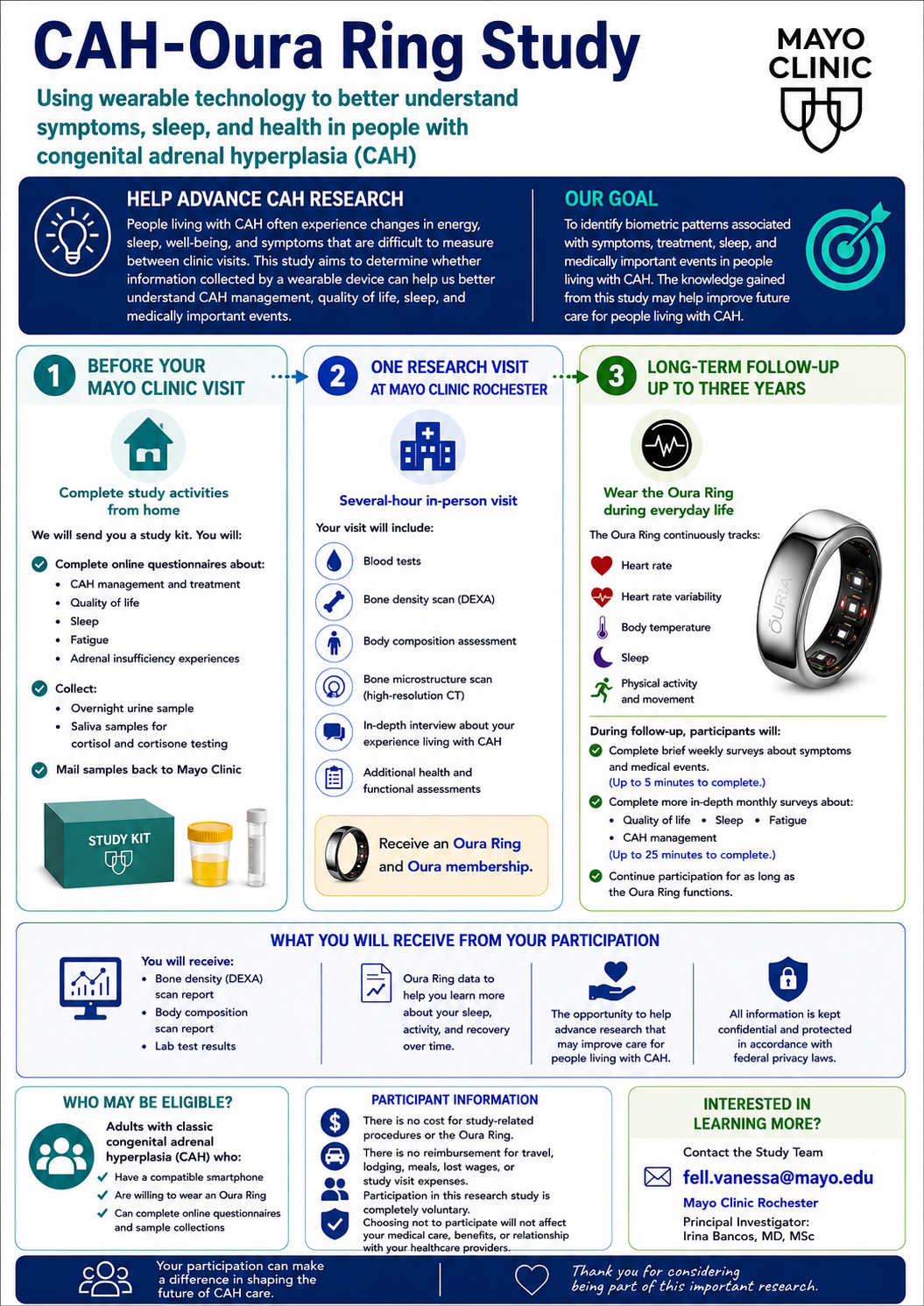
Enrolling adults diagnosed with classic CAH.
The study uses an Oura Ring to better understand how sleep, activity, heart rate, temperature, glucocorticoid therapy, and medical events relate to day-to-day health in patients experiencing adrenal insufficiency.
To learn more, contact the Vanessa Fell at fell.vanessa@mayo.edu.
RESET-MACS Study: A New Treatment Approach for Mild Autonomous Cortisol Secretion (MACS)
Adults age 18 years and older with diagnosed with Mild Autonomous Cortisol Secretion (MACS) may be eligible for a Mayo Clinic research study evaluating an investigational study drug, Metyrapone. The study lasts about 7 months, with an optional 6-month extension, and includes inpatient visits at Mayo Clinic in Rochester, Minnesota. Participants will be compensated for their time.
To learn more, contact the Vanessa Fell at fell.vanessa@mayo.edu or watch this video intro: RESET-MACS Clinical Trial.
new! emergency kits for adrenal insufficient patients
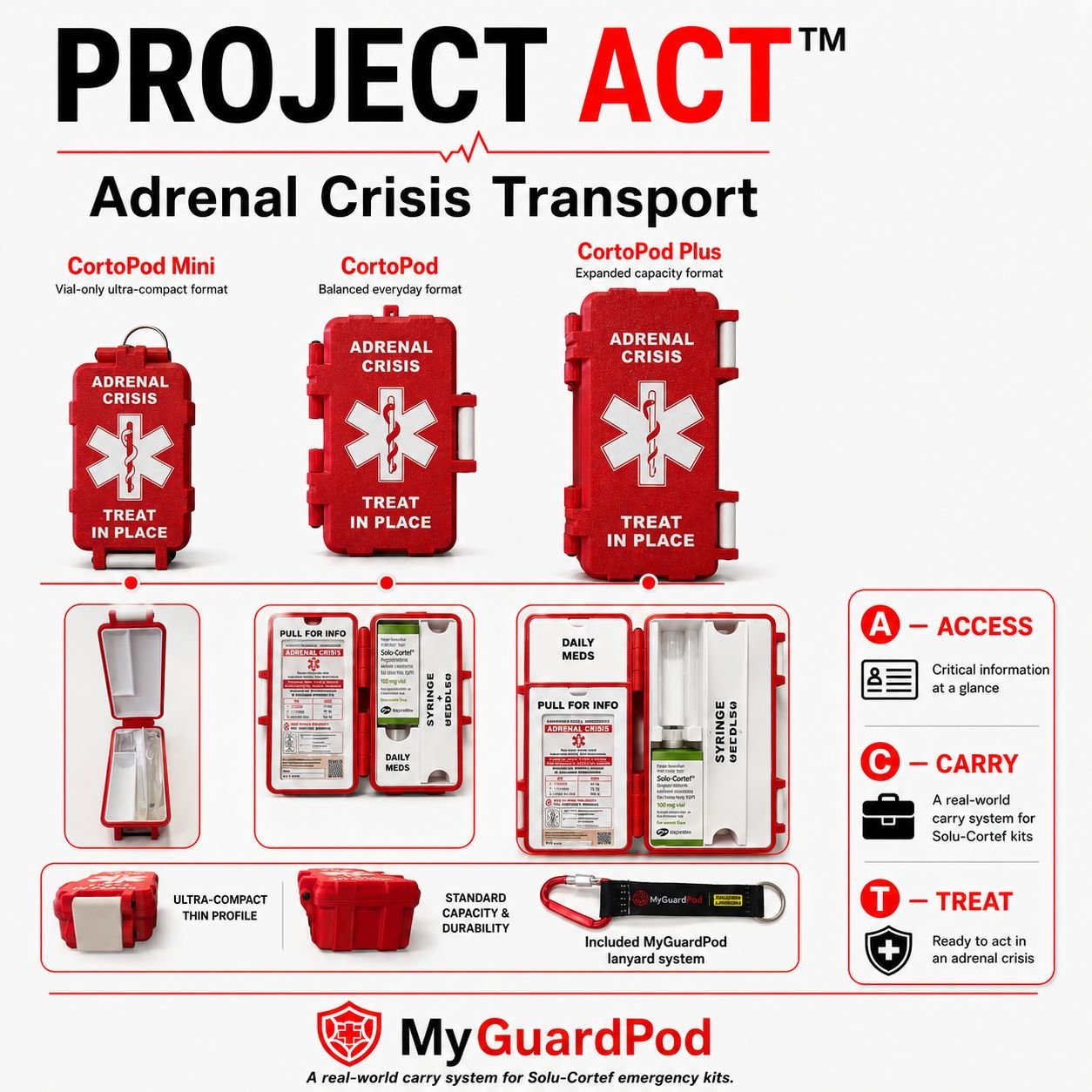
MyGuardPod started with a simple problem: emergency medications are fragile, expensive, and often carried in backpacks, purses, or pockets where they can be damaged. MyGuardPod is designed to protect life-saving medications from drops, impacts, and everyday life. Every case is 3D-printed by hand in Baie-Comeau, Québec — precision-engineered for a specific medication, tested for real-world conditions, and trusted by patients and caregivers around the world.
CortoPod Mini ACT: Ultra-compact backup option for the vial only.
CortoPod ACT: Balanced everyday format, regular in size.
CortoPod Plus ACT: Larger capacity model. Better option to keep two vials of Solu-Cortef in its original box.
Please note: Medication and medical supplies are not included. MyGuardPod does not provide medical protocols, training, or clinical guidance. Its role is to design and manufacture the protective carrying system that helps support emergency medication readiness.
To order your new Solu-Cortef® Carry Kit, visit https://myguardpod.com/project-act
We would also like to thank Alain for creating a special discount for the NADF community! Use the discount code NADF5 to receive 5% off your purchase. In addition, 5% of eligible sales made using this code will be donated back to NADF, helping support our mission to educate, advocate, and serve the adrenal disease community.
Now Recruiting: Neurocrine seeks young children with cah
Neurocrine announced the initiation of a Phase 2 study evaluating crinecerfont in children aged 3 months to under 4 years with classic CAH. CRENESSITY® is currently approved for adults and children ages 4 and older with classic CAH, and this study reflects the continued efforts to evaluate its potential in younger children. Click the button below to learn more.
Now Recruiting: Natera seeks individuals with cah
Natera researchers are recruiting individuals with CAH (21-OHD) and their biological mothers to participate in the DYADS study. The study involves collecting blood samples and health information to verify genetic information from each mother–child pair. The findings will support the development of a non-invasive prenatal screening tool that can help pregnant women determine whether their baby may be affected by CAH. Blood samples will be collected from the biological mother (carrier) and the biological child with CAH; families with an unaffected sibling may also be eligible to participate.
Participating in this study will be helping the future development of a non-invasive screen that will be offered to families to screen a fetus for the risk of CAH. Participants in this study would be compensated for their time.
Interested in participating?
To learn more or inquire about participation, visit the sponsor’s website or contact the Study Coordinator by phone: 650-674-4662 or email: DYADS@natera.com.
Eton Pharmaceuticals Announces US FDA Approval for KHINDIVI™ (hydrocortisone) Oral Solution
June 2, 2025
Eton Pharmaceuticals, Inc, an innovative pharmaceutical company focused on developing and commercializing treatments for rare diseases, today announced the U.S. Food and Drug Administration (FDA) approval of a New Drug Application (NDA) for KHINDIVI™ (hydrocortisone) Oral Solution as a replacement therapy in pediatric patients five years of age and older with adrenocortical insufficiency. Read more here >>
NADF Educational Videos Now Available on VuMedi
May 21, 2025
Several of NADF’s educational videos are now available on VuMedi, the leading video education platform for physicians. VuMedi hosts over 65,000 videos created by nationally recognized clinicians and academic partners, covering the latest medical advancements across 20+ specialties. Having our content featured on this respected platform is a major step forward in raising awareness and educating healthcare professionals about adrenal diseases.
Survey Study: Patient Experiences with Fludrocortisone
April 4, 2025
Background: Teva Pharmaceuticals has discontinued their production of fludrocortisone. Their formulation was well liked because it was a distinct color and shape, and also because it was easy to divide into a 0.05 mg dose that many patients need. The remaining manufacturers' configurations lack those characteristics. This results in a potential patient safety issue with both dosing correctly using pills that are not configured to split, and also a safety issue distinguishing fludrocortisone from hydrocortisone pills.
Further issues were raised about some patients feeling that their symptoms were altered when they used one of the other manufacturers products. A number of patients (31%) raised issues regarding new symptoms they experienced when taking the other manufacturers’ fludrocortisone, although they could not definitively say that these symptoms resulted from the change in medication. The symptoms described were common to AI symptoms in general.
We had a strong response from members regarding their experiences in the survey. There were 434 overall responses to the survey. Of those responses 193 had changed their fludrocortisone source, and of those who had changed, 60 reported that there was a difference in their symptoms.
Given the commonality of AI symptoms to the symptoms experienced due to changes in drug manufacturer, it is very difficult to assess causation beyond simply recognizing that some individuals experience this issue. Further, the survey did not reveal any significant patterns in relationship to a particular manufacturer.
NADF’s action plan is to draft a letter to the FDA describing the patient impacts of these changes - particularly the issues around patient safety - and ask for a response from them.
Study Sponsored by NADF: "People with Adrenal Insufficiency Who Are in Adrenal Crisis Are Frequently Unable to Self-Administer Rescue Injections"
March 3, 2025
From AACE Endrocrine Practice: "Individuals with adrenal insufficiency (AI) are at risk of acute adrenal crisis and death, particularly during illness or trauma, and may require rapid treatment with parenteral glucocorticoid such as hydrocortisone (HC) to manage a crisis. Current guidelines recommend timely self-injection in an evolving crisis. Little is known about the patient experience with emergency injections. We surveyed people with adrenal insufficiency regarding success with emergency injections.
... Effective, timely, management of an impending adrenal crisis can prevent progression to hospitalization, multisystem failure requiring ICU care, and death. Reliance solely on patient self-injection may result in worse outcomes. Treating physicians should include patient education about injections and specific practical instruction in the technique, as well as the potential need for assistance in a crisis. FDA approval of a glucocorticoid auto injector, greater engagement with EMS clinicians, hospital emergency staff, and other healthcare professionals, are key for future success in managing adrenal crises."
NADF's Statement on Norovirus Outbreak
January 11, 2025
Norovirus is the most common type of viral gastroenteritis that is always present. It often spreads quickly in nursing homes, prisons, and facilities where food preparation and inadequate sanitation coexist. It is very contagious. The usual source is contaminated food. It can be spread by eating the food, touching contaminated dishes and utensils, and touching contaminated surfaces.
Symptoms are nausea, vomiting, diarrhea, abdominal pain, headache, and sometimes fever. The symptoms occur 12 to 48 hours after exposure, and typically last 1 to 3 days. Victims of the virus may remain contagious for several days after symptoms are gone. There is no specific drug for norovirus. Antibiotics do not help. Treatment is general support: replacement fluids, antinausea and anti-diarrhea medications, and treatment of any fever.
The best way to avoid norovirus is frequent hand washing. Masks are not effective against norovirus because it is not a respiratory disease. A mask might help if it reminds you not to touch your face. To protect yourself, wash hands thoroughly, disinfect surfaces, avoid touching your face.
Since individuals with adrenal insufficiency have a diminished tolerance for gastroenteritis, they need to be vigilant if they are aware of an outbreak in their neighborhood. Be prepared to treat the symptoms, replacing fluids aggressively, and take extra glucocorticoids according to the usual illness protocols. As usual, go to an emergency department if fluid loss from vomiting and diarrhea cannot be controlled.
Prepared by NADF Medical Director, Dr. Paul Margulies
For more information see:
NADF and Prodigy EMS Announce Free Webinar: "Recognizing and Managing Adrenal Crisis in the Field with NADF"
Experts in endocrinology and emergency care will guide attendees through real-life case studies and practical strategies for managing adrenal crises in the field. Attendees will gain insights into the nuances of glucocorticoid and mineralocorticoid deficiencies, fluid resuscitation protocols, and the administration of life-saving steroids—whether in the form of carried medications or assisting with patient-provided solutions. Free CE for EMS Clinicians.
Speakers: Christopher Galton, MD; Mitchell Geffner, MD; Vanessa O’Rourke
Free account required for viewing
FDA Approves New CAH Medication CRENESSITY™
December 20, 2024
The FDA has approved CRENESSITY™ (crinecerfont) as an adjunctive treatment to glucocorticoid replacement to control androgens in adult and pediatric patients 4 years of age and older with classic congenital adrenal hyperplasia (CAH).
CRENESSITY is a first-in-class treatment developed for individuals living with classic CAH. It is a breakthrough in the treatment landscape for this rare, serious, and lifelong genetic condition involving the adrenal glands. This approval marks a significant step forward in classic CAH treatment, and we're excited about its possibilities to improve patients’ lives.
FDA Approves New CAH Medication CRENESSITY™
December 20, 2024
The FDA has approved CRENESSITY™ (crinecerfont) as an adjunctive treatment to glucocorticoid replacement to control androgens in adult and pediatric patients 4 years of age and older with classic congenital adrenal hyperplasia (CAH).
CRENESSITY is a first-in-class treatment developed for individuals living with classic CAH. It is a breakthrough in the treatment landscape for this rare, serious, and lifelong genetic condition involving the adrenal glands. This approval marks a significant step forward in classic CAH treatment, and we're excited about its possibilities to improve patients’ lives.
New NADF Blog: "A Day in the Life" Vignettes
November 5, 2024
NADF has added a new section to the quarterly newsletter, "A Day in the Life" vignettes. These vignettes will be collected on the NADF website as a blog series. Each entry details a day in the life of someone with adrenal insufficiency and shows them reacting to different stressors. The story is followed by a question section designed to engage the reader in critical thinking about proactive choices for living an adrenal insufficient life of the highest quality. Entries are written by Susan Majka, NADF Treasurer.
NAEMSP Blog: "Adrenal Crisis and Addison's Disease: What EMS Needs to Know"
October 14, 2024
The National Association of EMS Physicians (NAEMSP), in collaboration with NADF, has published an article on their blog titled, "Adrenal Crisis and Addison's Disease: What EMS Needs to Know". The article includes information on primary and secondary adrenal insufficiency, EMS treatment of adrenal crisis, and key considerations for EMS. This is part of NADF's ongoing EMS education efforts.
Exciting Announcement from the Adrenal Insufficiency Registry (MyAI) Research Team
The MyAI Registry participants are invited to enroll into the DNA and Cortisol studies. There is no cost to participate in either study, and you may choose to participate in both! You will be provided with the sampling kits, mailing containers, and shipping labels. Click here for the QR code and more information on how to enroll:
NADF.us/dna-and-cortisol-studies.html
Eton Pharmaceuticals Announces FDA Approval of Orphan Drug ALKINDI® SPRINKLE (hydrocortisone) as Replacement Therapy in Pediatric Patients with Adrenocortical Insufficiency
September 29, 2020
ALKINDI SPRINKLE is the first and only FDA-approved granular hydrocortisone formulation for adrenocortical insufficiency specifically designed for children. Eton expects ALKINDI SPRINKLE to be available in the fourth quarter of 2020.