

Cushing’s Syndrome
What is Cushing’s Syndrome?
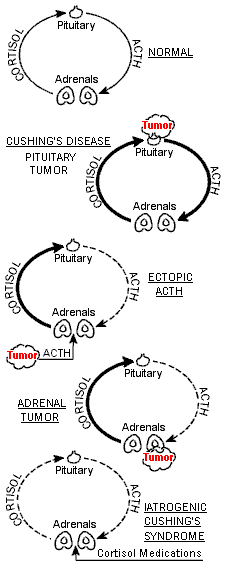
Cushing’s syndrome is a disease caused by an excess of cortisol production or by excessive use of cortisol or other similar steroid (glucocorticoid) hormones.
CORTISOL is a hormone produced in the outer portion, or cortex, of the adrenal glands, located above each kidney. The normal function of cortisol is to help the body respond to stress and change. It mobilizes nutrients, modifies the body’s response to inflammation, stimulates the liver to raise the blood sugar, and it helps control the amount of water in the body.
Another adrenal cortex hormone, ALDOSTERONE, regulates salt and water levels which affects blood volume and blood pressure. Small amounts of androgens (male hormones) are also normally produced in the adrenal cortex. Cortisol production is regulated by adrenocorticotrophic hormone (ACTH), made in the pituitary gland, which is located just below the brain.
When too much cortisol is produced in the adrenal glands, or an excess of corticosteroids are taken to treat other diseases, significant changes occur in all of the tissues and organs of the body. All of these effects together are called Cushing’s syndrome.
Cushing’s disease is a type of Cushing’s syndrome caused by too much ACTH production in the pituitary. Dr. Harvey Cushing first described a woman with signs and symptoms of this disease in 1912, and in 1932 he was able to link the adrenal overproduction of cortisol to an abnormality in the pituitary.
What Causes Cushing’s Syndrome?
Excess levels of the hormone cortisol cause Cushing’s syndrome, which can occur in the following ways:
Iatrogenic (medication-induced) origin:
Occurs when cortisol or other glucocorticoid hormones (such as hydrocortisone, prednisone, methyl-prednisolone or dexamethasone) are taken in excess of the normal daily requirement for a prolonged period of time (e.g., in treatment of certain life-threatening illnesses such as asthma, rheumatoid arthritis, systemic lupus, inflammatory bowel disease, some allergies, etc.)
Spontaneous (endogenous) overproduction of cortisol in the adrenals, which is divided into two categories:
Those due to an excess of ACTH:
Cushing’s disease, most commonly a pituitary tumor producing too much ACTH, stimulating the adrenals to grow (hyperplasia) and to produce too much cortisol. (cause of 70% of spontaneous Cushing’s syndrome).
Ectopic ACTH production:ACTH is produced outside the pituitary in a benign or malignant tumor in the lung, thymus gland, pancreas, or other organ.
Those that are independent of ACTH:
Adrenal tumors; The tumor produces cortisol on its own causing the other adrenal gland to shrink due to lower ACTH production. Most adrenal tumors are benign (an adenoma).
Adrenal carcinoma: Malignant adrenal tumors (carcinoma) are very uncommon but have a high mortality rate.
Bilateral adrenal adenoma: A rare type which is caused by multiple benign adenomas on both adrenals (inherited form is called Carney complex).
Although almost all types of spontaneous Cushing’s syndrome are ultimately caused by one type of tumor or another, little is known about what makes these tumors occur. Aside from the genetic cause of Carney complex, we still have limited understanding about the factors that cause most forms of Cushing’s syndrome.
How common is Cushing’s Syndrome?
Iatrogenic : Cushing’s syndrome from taking steroid medication is extremely common because of the widespread use of these medicines in treating many illnesses.
Spontaneous (endogenous): Cushing’s syndrome including Cushing’s disease can occur in children and adults.
Pituitary Cushing’s disease generally occurs after puberty with equal frequency in boys and girls. In adults, it has a greater frequency in women than men, with most found at age 25 to 45. The total incidence is about 5 to 25 cases per million people per year.
Ectopic ACTH as a cause of Cushing’s syndrome is most frequently due to benign or malignant lung tumors, and often goes unrecognized. The incidence increases with age.
The incidence of adrenal tumors is as high as 7% in the elderly. Most do not cause overt Cushing’s syndrome, but a significant number demonstrate mild autonomous cortisol secretion (called MACS).
What Are the Signs and Symptoms of Cushing’s Syndrome?
Cortisol excess produces significant and serious change in the appearance and health of affected individuals. Depending on the cause and duration of the Cushing’s syndrome, some people may have more dramatic changes, some might look more masculinized, some may have more blood pressure or weight changes.
General physical features, noted on physical examination, include:
A tendency to gain weight, especially on the abdomen, face (moon face), neck and upper back (buffalo hump)
Thinning and weakness of the muscles of the upper arms and upper legs
Thinning of the skin, with easy bruising and pink or purple stretch marks (striae) on the abdomen, thighs, breasts and shoulders
Increased acne, facial hair growth, and scalp hair loss in women
Sometimes a ruddy complexion on the face and neck
Often a skin darkening (acanthosis) on the neck
In children, obesity and poor growth in height
In addition, high blood pressure is usually found, and sometimes some enlargement of the clitoris in females. Symptoms also include fatigue, weakness, depression, mood swings, increased thirst and urination, and lack of menstrual periods in women.
Common findings on routine laboratory tests in people with Cushing’s syndrome include:
elevated white blood count
high blood sugar (often into the diabetic range)
low serum potassium
Ectopic Cushing’s syndrome tends to present with less impressive classic features, but more dramatic hypertension and loss of potassium, sometimes in the setting of weight loss from the underlying cancer.
If untreated, Cushing’s syndrome will cause continued weakness of the muscles, fatigue, poor skin healing, weakening of the bones of the spine (osteoporosis), and increased susceptibility to some infections including pneumonia and TB.
How Is Cushing’s Syndrome Diagnosed?
Most people who appear to have some of the classic physical features of Cushing’s syndrome (Cushingoid appearance) do not actually have the endogenous disease. These features can also be caused by other conditions, include iatrogenic Cushing’s (high dose steroids taken for treatment of another condition), polycystic ovary syndrome (androgen excess from the ovaries), ovarian tumors, congenital adrenal hyperplasia, ordinary obesity, excessive alcohol consumption, or a family tendency to have a round face and abdomen with high blood pressure and high blood sugar.
Because endogenous Cushing’s syndrome is a rare but serious disorder, it is very important to first rule out these other conditions and then determine the specific type of Cushing’s syndrome and its underlying cause. This diagnostic process usually takes days to weeks and requires patience and cooperation from the person being evaluated.
The evaluation typically begins with a medical history, physical examination, and routine blood tests, followed by specialized testing.
Prove cortisol excess with specific blood, saliva and 24-hour urine tests for cortisol. Since cortisol is normally very low at midnight, an elevated midnight salivary cortisol is very useful. If these tests are abnormal:
Perform dexamethasone suppression test where dexamethasone (steroid) pills are given by mouth; blood and urine are collected for cortisol and other adrenal hormones.
Note: A screening test might be done initially with an overnight test, but if it is abnormal, a 4-day test divided into low and high dose dexamethasone is usually needed.
To separate ACTH-dependent from ACTH-independent types, additional testing is needed:
Morning blood test for ACTH
Blood and urine tests for adrenal androgens
Metyrapone and CRH (corticotropin releasing hormone), if needed
Once all of the blood and urine results are analyzed, they will establish whether some type of Cushing’s syndrome is present and should indicate whether the disease is ACTH dependent (pituitary or ectopic) or independent (an adrenal tumor).
Localizing techniques such as CT or MRI are then used to find the tumor. Often a pituitary tumor is tiny and hard to find, so a special test of the release of ACTH from both sides of the pituitary (petrosal sinus sampling) might be needed. Small tumors producing ectopic ACTH are also sometimes difficult to localize and require repeated scans and x-rays.
How Is Cushing’s Syndrome Treated?
Treatment options will depend on the type of Cushing's syndrome diagnosed.
Iatrogenic Cushing’s: Withdraw steroid medicines to allow the body to go back to normal, if the type of disease being treated and the pattern of response will allow.
If steroids cannot be totally stopped or can be reduced only to a limited degree because the underlying illness would worsen, some degree of persistent Cushing’s syndrome would remain as an unwanted side effect. Treatment of these effects would include:
management of high blood sugar with diet and medications
replacement of potassium
treatment of high blood pressure
early treatment of any infections
adequate calcium intake
appropriate adjustments in steroid doses at times of acute illness, surgery or injury
Cushing’s disease:
Removal of the pituitary tumor is performed, usually with transsphenoidal resection (behind the nose) by a neurosurgeon.
If the entire pituitary gland is removed or injured, deficiencies of ACTH and other pituitary hormones will result; replace hormones – cortisol, thyroid and gonadal (sex) hormones. Fertility can be restored with special hormonal therapies.
If the tumor cannot be removed, radiation therapy to the pituitary can be used, but the improvement of symptoms is much slower.
Before the endoscopic transsphenoidal surgery became available, the surgical removal of both adrenal glands was common, but this always produced adrenal insufficiency and sometimes caused large ACTH-producing pituitary tumors to grow (called Nelson’s syndrome). That is why pituitary surgery rather than adrenal surgery is usually preferred for Cushing’s disease.
Ectopic ACTH producing tumors:
If malignant (cancer)—tumor is removed or treated with radiation/chemotherapy to improve symptoms.
If benign, or it can be completely removed, surgery may be a cure.
Most of the time, reduction of the cortisol production from the adrenals with medications such as metyrapone, amino-glutethimide or ketoconazole is useful while the ACTH-producing tumor is treated.
Adrenal carcinomas (cancer) can be cured if removed early. Unfortunately, they are usually discovered after they have already spread beyond the adrenal gland and are then not curable. Chemotherapy including o’p’DDD and other medicines are often used to try to control the tumor but do not cure it. The excess cortisol production can be controlled with o’p’DDD or by other medications like those mentioned for ectopic ACTH production.
All of these medicines can have serious side effects and require very careful monitoring and balancing with steroid hormone replacement therapies. Surgical cure of the primary cause of the Cushing’s syndrome is always the best, if possible.
How Normal Is a Cushing’s Syndrome Patient’s Life?
The symptoms, disabilities and life-style of a person with Cushing’s syndrome depend on the degree of cortisol excess, the duration of the disease, the basic health of the person, but especially the type and curability of the Cushing’s syndrome. If it is cured, all of the features of the disease can resolve, but this may take as long as 2 to 18 months.
During that time, many patients may become frustrated by the slow improvements in physical changes and the combination of Cushing’s and adrenal insufficiency signs and symptoms (dizziness, weakness, nausea, loss of appetite) as replacement steroid hormones are tapered and adrenal hormone production slowly improves toward normal. Frequent calls and visits to physicians are necessary.
If the Cushing’s syndrome is incurable, or if iatrogenic Cushing’s syndrome must remain, these individuals will have to cope with persistent fatigue, muscle weakness, abdominal and facial weight gain, depression, mood swings, and all the other signs and symptoms mentioned earlier. Regular visits to a physician for examinations, blood tests, and treatments of infections and complications will be necessary and are often viewed as a severe burden.
Why Consult an Endocrinologist?
Iatrogenic Cushing’s syndrome is generally managed by the physician prescribing the steroid hormones for the primary illness, such as asthma, arthritis, or inflammatory bowel disease. Sometimes physicians are able to decrease steroid doses by using other drugs in the treatment of these diseases.
All of the types of spontaneous Cushing’s syndrome should be carefully evaluated by an endocrinologist (a specialist in hormonal disease) who has the knowledge and experience in choosing the correct diagnostic studies and evaluating the results. Finding the correct diagnosis often requires prolonged testing and even repetition of tests. Quick shortcuts can be misleading. Referrals for surgery or radiation should be coordinated by the endocrinologist, who will also be directly involved in managing the patient afterwards.
New Treatments
If Cushing’s disease is not cured by surgery; or if there is persistent elevation of cortisol from ectopic ACTH production, or a residual adrenal tumor or cancer, then medical management is needed. Several medications have been used for many years, including: ketoconazole, metyrapone, etomidate, and o’p’DDD. Each of these medications, or combinations of them, can reduce cortisol levels, but the medications can have significant side effects.
Four newer treatments are now available.
Pasireotide (Signifor) suppresses ACTH in persistent pituitary Cushing’s disease.
Mifepristone (Korlym) blocks the cortisol receptor and reduces the effect of persistent high cortisol.
Osilodrostat (Isturisa) inhibits an enzyme, blocking cortisol synthesis.
Recorlev (levoketoconazole) is a safer and more effective form of ketoconazole that inhibits 3 enzymes involved in the synthesis of cortisol.
These new treatments have a range of side effects, so patients must be carefully monitored. They potentially offer significant benefits and can be used in combination with older therapies.
The answers above were provided by:
Paul Margulies, MD, FACE, FACP, Medical Director, NADF.
Clinical Associate Professor of Medicine, Zucker School of Medicine at Hofstra/Northwell.